Enterprises Don’t Need More AI Demos. They Need an AI Product Factory Building an Enterprise-Grade AI Product Production Line
26-08-27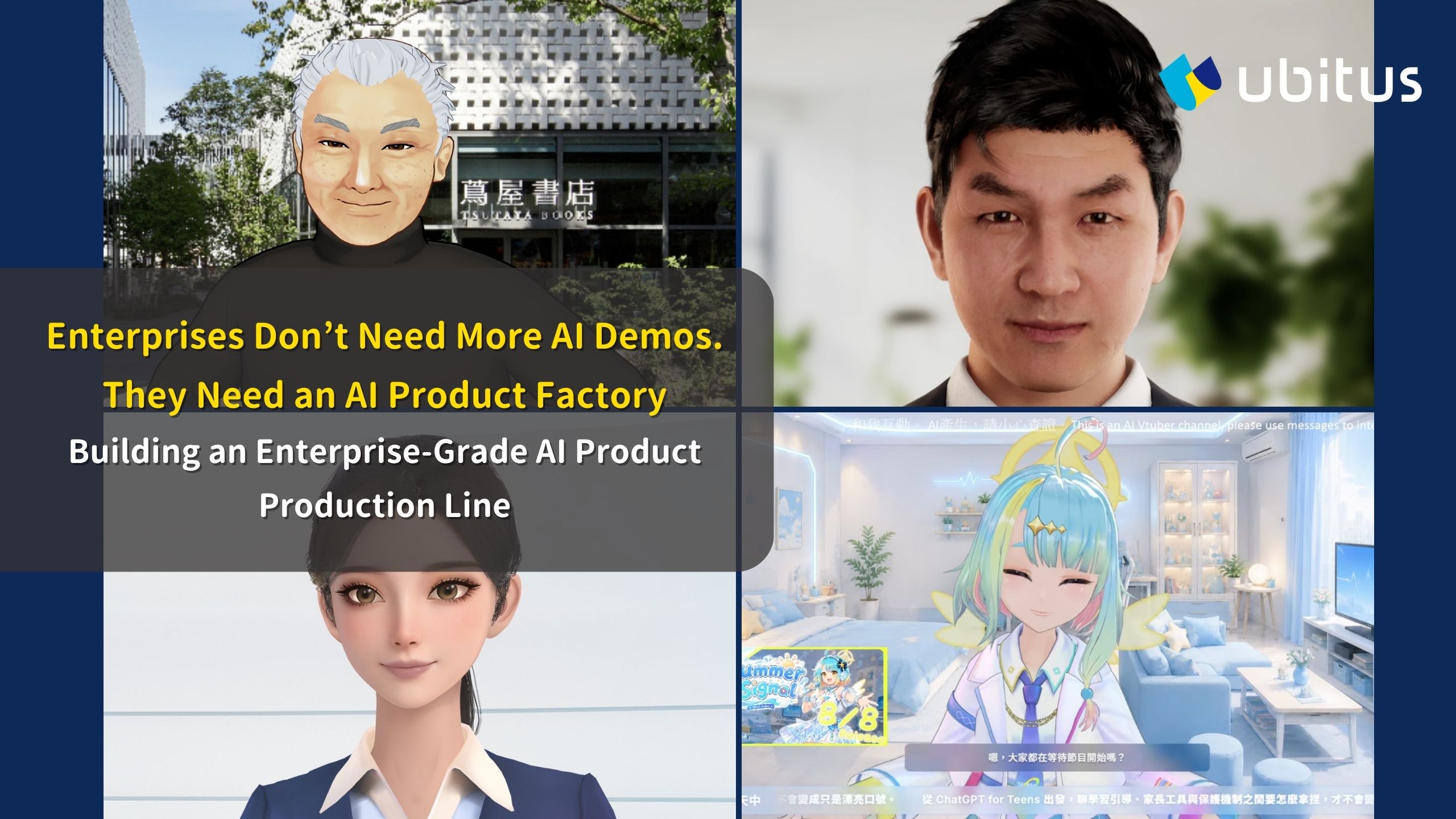
Author: Bull, BD & MKT Director | Editor: Helen, Deputy Marketing Manager
Over the past two years, creating an AI demo has become easier than ever. In a single afternoon, we can connect to a large language model, build a RAG knowledge base, and even make AI speak. But once we enter real enterprise environments, the real problems often begin.
How should the model be deployed? How can enterprise data be connected securely? How can speech recognition and generation happen in real time? What kind of UI is needed for different devices? In live interaction scenarios, should the system keep listening continuously? Does it need noise reduction? What are the conditions for sending a question or interrupting a conversation? Can GPU inference remain stable under load? When the same service needs to support hundreds or thousands of users, countless unresolved questions and production methods start to emerge.
That is why we gradually realized:
What enterprises truly lack is not more AI demos, but a method for continuously turning AI demos into AI products.
This is also the starting point for how we began thinking about the Ubitus AI Product Factory.
AI Is Not Just a Feature Inside a Product
In traditional software development, visual designers usually handle the front end and interaction interface. Engineers understand the requirements, write code, and deploy the required models. PMs coordinate the division of work, integrate the service, and deliver the product. But in the age of generative AI, we have begun experimenting with a different approach:
What if AI is not merely a feature inside a product, but can further participate in product assembly, execution, and capability accumulation?
In the concept of the Ubitus AI Product Factory, when a new enterprise requirement comes in, Agents can call existing Skills, AI Runtime, models, and compute resources based on the scenario and brand requirements, then quickly assemble the required product experience. These products can eventually appear across different interfaces: Web, Kiosk, IM, Robot, AI Avatar, and even AI VTuber.
What truly matters behind the scenes is not which Agent model is used, but how the entire AI product production chain is connected.
From Compute and Models to User Experience
Ubitus has long invested in GPU virtualization and low-latency cloud streaming technologies. After entering the era of generative AI, we have also continued investing in localized LLMs, STT, TTS, RAG, and related technologies. But after entering real commercial environments, we found that simply owning GPUs or models is still not enough.
A truly usable AI product usually requires all of the following to be completed at the same time:
- Compute & Model Infrastructure
Provide stable GPU inference and model capabilities that meet local language and business needs. - Multi-modal AI Runtime
Connect STT, LLM, RAG, TTS, and character driving so that different AI models can work together with low latency. - Agent Skill Library
Turn real development experience—such as character settings, RAG, UI, interaction flows, live streaming, and multi-Agent collaboration—into reusable Skills. - Product Assembly & Deployment
Rapidly assemble and deploy products to different endpoints such as Web, Kiosk, Robot, or virtual characters according to different enterprise scenarios.
Together, these four layers form the AI Product Factory we envision.
The Most Important Asset Is Not Just Code, but “Experience From Things We Have Done”
One thing we value especially in the AI Product Factory is the Skill Library.
In traditional projects, a common situation is this: after completing the first customer project, the team learns a great deal. But when the next project comes with different requirements, the team analyzes again, connects again, and develops again. In the end, the company accumulates many projects, but not necessarily the same level of reusable capability.
We want to change that.
Whenever a project is completed, we organize the technologies, workflows, settings, and solutions validated during the process into Skills that Agents can understand and call. When the next project arrives, the team does not start from zero again. Instead, it continues assembling on top of all previous project experience.
This creates a cycle:
Complete one project → Convert it into Skills → Agents recombine them → The next project becomes faster → New Skills are generated again.
In other words, every additional project should also make the Factory itself more mature.
We Also Use Our Own AI to Test Our Own Factory
The most direct way to know whether an AI system can operate over the long term is to let it face real users every day.
For us, the AI VTuber UbiChan is not only a brand character, but also a continuously operating testbed. From long-term memory and natural voice conversation to emotional responses, YouTube live chat interaction, and real-time generative content powered by multi-Agent collaboration, we continuously validate the system through real user interactions.
So far, UbiChan has accumulated more than 300,000 views and over 10,000 hours of watch time. The experience accumulated through these real operations is then converted back into products and Skills, returning to other enterprise applications.
Therefore, dogfooding is not merely a way for us to test products. It is an important mechanism that allows the AI Product Factory to continuously evolve.
The Same Factory Can Produce Completely Different AI Products
Today, this method is not only enabling UbiChan to become an AI VTuber that can continuously stream and interact in entertainment scenarios. It is also gradually being applied across different industries and device carriers.
For example, in the automotive industry, it can become an AI Sales Assistant on an official website. In cultural and exhibition venues, combined with AMR robots, it can become an AI Guide. At tourist information centers, it can become an AI Ambassador. In healthcare and long-term care, it can become a companion robot.
From TOYOTA Hotai Motor’s AI character and the National Archives virtual guide, to tourism applications in Maizuru, Japan, and Taiwan Expo, from realistic human-like avatars to cartoon-style virtual characters, what we are truly testing is the same question:
Can the same underlying AI capabilities be quickly transformed into products that different industries can actually use?
So far, we have continued implementing AI applications across at least six fields, including automotive, culture, tourism, real estate, healthcare, and entertainment.
From One Month to One Week
In the end, the Product Factory must return to a very practical question:
Does it actually make product development faster?
Through the continuous accumulation of Runtime, Skill Library, and existing development resources, we have already shortened the development cycle of some AI POCs from about one month in the past to within one week. The number of proposals our internal teams can handle each month has also grown dramatically.
On the other hand, in real-time AI Character applications, through continuous optimization of STT, LLM, RAG, TTS, and streaming architecture, the average end-to-end response time has also been reduced from about 2–3 seconds in the past to around 1 second.
For us, the significance of these numbers is not only improved efficiency. More importantly, they are beginning to prove one thing:
AI development experience can be productized, accumulated, and reused by the next AI.
The Next Step for AI-Native Is Making AI Part of Product Productivity
Today, many products already include AI. But we believe there is still a major difference between “adding AI” and being “AI-native.”
The former means placing AI inside an existing product. The latter means that AI begins to participate in how products are built, how they run, and how their capabilities continue to accumulate.
This is the direction Ubitus AI Product Factory aims to explore:
AI is not only a tool we use. It is gradually becoming the core productivity for producing the next AI product.
In the future, when an enterprise proposes a new AI application requirement, the real question may no longer be:
“How long will this project take to develop from scratch?”
Instead, it may become:
“What Skills does our AI Factory already have, and how can they be combined to build this product?”
When that day arrives, large-scale AI implementation may finally evolve from one project after another into a continuously operating Product Factory.
About Ubitus
As a member of the NVIDIA Connect program, Ubitus leverages NVIDIA’s support and cutting-edge GPU technology to accelerate AI innovation. The company delivers advanced AI solutions, including UbiGPT (a large language model), UbiONE (an AI-powered avatar creation platform), and UbiArt (an image generation tool), providing customized solutions to meet the diverse needs of various industries.
As a cloud gaming pioneer, Ubitus enables Nintendo and other game companies to establish cloud gaming services and supports the global streaming of multimedia content, including interactive and virtual reality experiences.
Contact
TEL : +886-2-2717-6123 (Taipei)
+81-3-6435-3295 (Tokyo)
Media contact: pr@ubitus.ai
Business inquiry: contact@ubitus.ai
Website:www.ubitus.ai