Ubitus Showcases AI Healthcare Companion at Healthcare+ Expo Taiwan 2026
26-11-13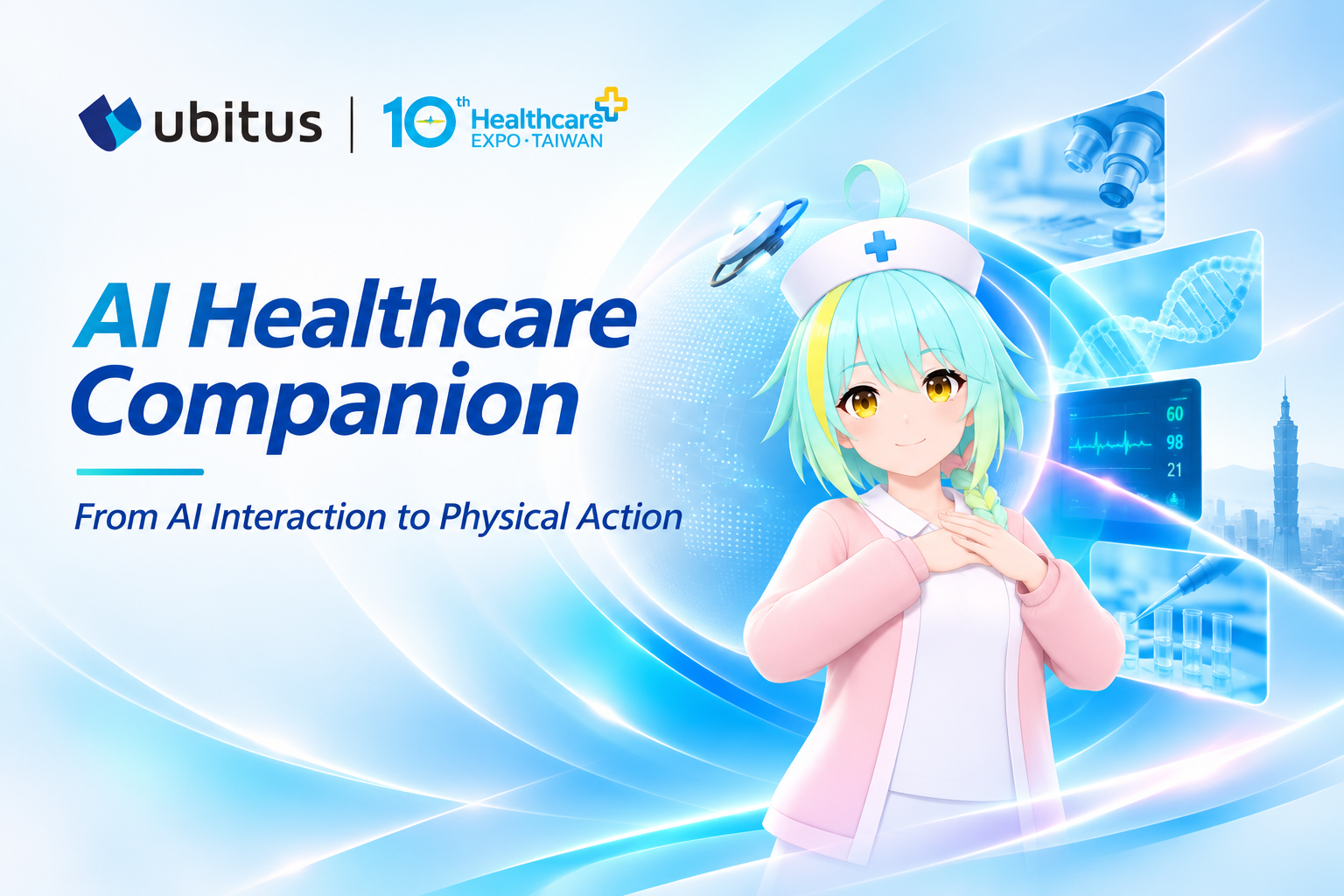
Integrating AI Virtual Humans, Companion Robots, and Autonomous Mobile Robots, with Supermicro and Intel Supporting AI Hardware and Software Integration for Healthcare Applications
Ubitus, a global provider of cloud streaming and artificial intelligence technologies, will participate in Healthcare+ Expo Taiwan 2026, taking place from December 3 to 6, 2026. At Booth N1031 in the Smart Healthcare Zone on the 4th floor of Taipei Nangang Exhibition Center, Hall 1, Ubitus will showcase its AI Healthcare Companion, highlighting its integrated technology capabilities spanning AI Computing, AI Models, and AI Applications.
The exhibition will also feature computing equipment provided by Supermicro and Intel, alongside AI Virtual Humans, Kebbi AI Robots, and Autonomous Mobile Robots (AMRs). Through demonstrations of real-time voice interaction, visual perception, healthcare knowledge assistance, and AI Agent task execution, Ubitus will illustrate how AI can extend beyond digital interactions into physical services, exploring innovative applications in smart healthcare, long-term care, and companion care.
From AI Characters to Physical AI: Building Intelligent Healthcare Companions That Can Perceive, Understand, and Act
As generative AI and robotics continue to evolve, smart healthcare applications are moving beyond standalone question-and-answer tools toward AI Agents capable of understanding user needs, proactively engaging with users, and assisting with real-world tasks.
Centered on AI Healthcare Companion, Ubitus integrates Voice, Vision, Large Language Models (LLMs), AI Agents, and Robot Control technologies to demonstrate a complete AI workflow: Understand → Interact → Reason → Act.
At the exhibition, AI Virtual Humans and Kebbi AI Robots will demonstrate natural voice conversations, healthcare education Q&A, and interactive companionship. By incorporating Healthcare Retrieval-Augmented Generation (RAG), AI can provide real-time responses based on designated healthcare education content.
With Vision AI and multimodal models, the system can further recognize user movements and understand surrounding environments, enabling interactive activities such as rock-paper-scissors, gesture imitation, and simple physical challenges. These demonstrations highlight the potential of AI-powered companionship for children, older adults, and patients.
Ubitus will also demonstrate the integration of AI Agents with Autonomous Mobile Robots (AMRs). Once an AI Virtual Human understands a user’s request, an AI Agent can plan tasks and issue commands, enabling an AMR to perform physical actions such as guiding visitors, moving between locations, or retrieving items. This showcases the technological progression from digital AI characters to Physical AI.
From GPU Computing to AI Applications: Demonstrating End-to-End AI Integration
Beyond front-end interactive experiences, Ubitus will present the computing infrastructure and technical architecture supporting smart healthcare applications, demonstrating its capabilities across GPU Computing, AI Models, Inference, and Application Integration.
The planned demonstrations will incorporate NVIDIA Nemotron models, NVIDIA NIM Microservices, NVIDIA NeMo Retriever, CUDA, and TensorRT technologies to integrate real-time speech recognition, multimodal understanding, large language model inference, and Retrieval-Augmented Generation (RAG). These capabilities support diverse interactions involving AI Virtual Humans, companion robots, and AMRs.
From an infrastructure perspective, Ubitus will demonstrate how AI applications can be deployed according to different operational requirements, ranging from NVIDIA Jetson edge computing and DGX Spark local AI computing environments to NVIDIA B200/B300 GPU data center infrastructure, supporting AI inference and deployment at different scales.
Ubitus’s core strength extends beyond individual AI models or applications. By integrating computing infrastructure, model services, and front-end interaction systems, the company helps enterprises and healthcare institutions advance AI technologies from Proof of Concept (PoC) toward practical deployment.
Integrating AI Computing and Local Deployment to Meet Healthcare Requirements
When adopting generative AI, healthcare institutions must consider not only application performance but also data security, privacy protection, and integration with existing IT environments.
To address these requirements, Ubitus will showcase Local AI and On-premise AI Deployment architectures, demonstrating how AI models and inference services can operate within local computing environments.
The exhibition will also feature computing equipment provided by Supermicro and Intel, with Intel supporting AI PC-related demonstrations. Combined with Ubitus’s expertise in AI model inference, virtual human interaction, and application integration, these demonstrations will highlight the potential of integrated AI hardware and software solutions and Local AI applications.
Through local GPU computing environments, core capabilities such as speech recognition, visual understanding, large language models, and RAG can be deployed within hospitals or enterprise infrastructure according to operational needs. This approach reduces reliance on external cloud AI services while providing greater flexibility in computing resource allocation.
From local AI applications running on individual devices to data center-scale GPU infrastructure for large healthcare institutions, Ubitus aims to provide flexible deployment architectures that help healthcare organizations evaluate AI solutions aligned with their information security policies and operational requirements, supporting the practical adoption of smart healthcare technologies.
Advancing AI Integration in Healthcare and Driving Innovation in Intelligent Care
Ubitus continues to expand its AI technologies across smart healthcare and robotics, ranging from AI Virtual Humans, multilingual interaction, and healthcare knowledge services to physical robots integrated with AI Agents. These developments contribute to an expanding portfolio of AI solutions connecting digital interaction with physical services.
Ubitus stated:
“The value of AI in healthcare goes beyond improving access to information and interaction efficiency. It lies in combining computing power, AI models, and real-world operational needs to create intelligent services capable of understanding, interacting, and assisting with task execution. Through AI Healthcare Companion, Ubitus aims to demonstrate its integration capabilities from AI Infrastructure to Physical AI, deepen collaboration with the healthcare industry, and bring AI technologies into real-world care environments.”
Through Healthcare+ Expo Taiwan 2026, Ubitus looks forward to engaging with healthcare institutions, technology companies, and industry partners to explore AI adoption requirements and collaboration opportunities.
Guided by its brand vision, “Powering AI from Compute to the Real World,” Ubitus remains committed to advancing AI from computing infrastructure to real-world applications.
Exhibition Information
- Event: Healthcare+ Expo Taiwan 2026
- Dates: December 3 (Thursday) – December 6 (Sunday), 2026
- Venue: Taipei Nangang Exhibition Center, Hall 1, 4F Smart Healthcare Zone
- Ubitus Booth: N1031
- Registration: https://expo.taiwan-healthcare.org/zh/exhibit/book2026.php
Ubitus Donates GPU Server to National Central University to Advance Taiwan’s Sovereign AI Development, Building on Its Experience in Local AI Applications with TAIDE
26-11-12
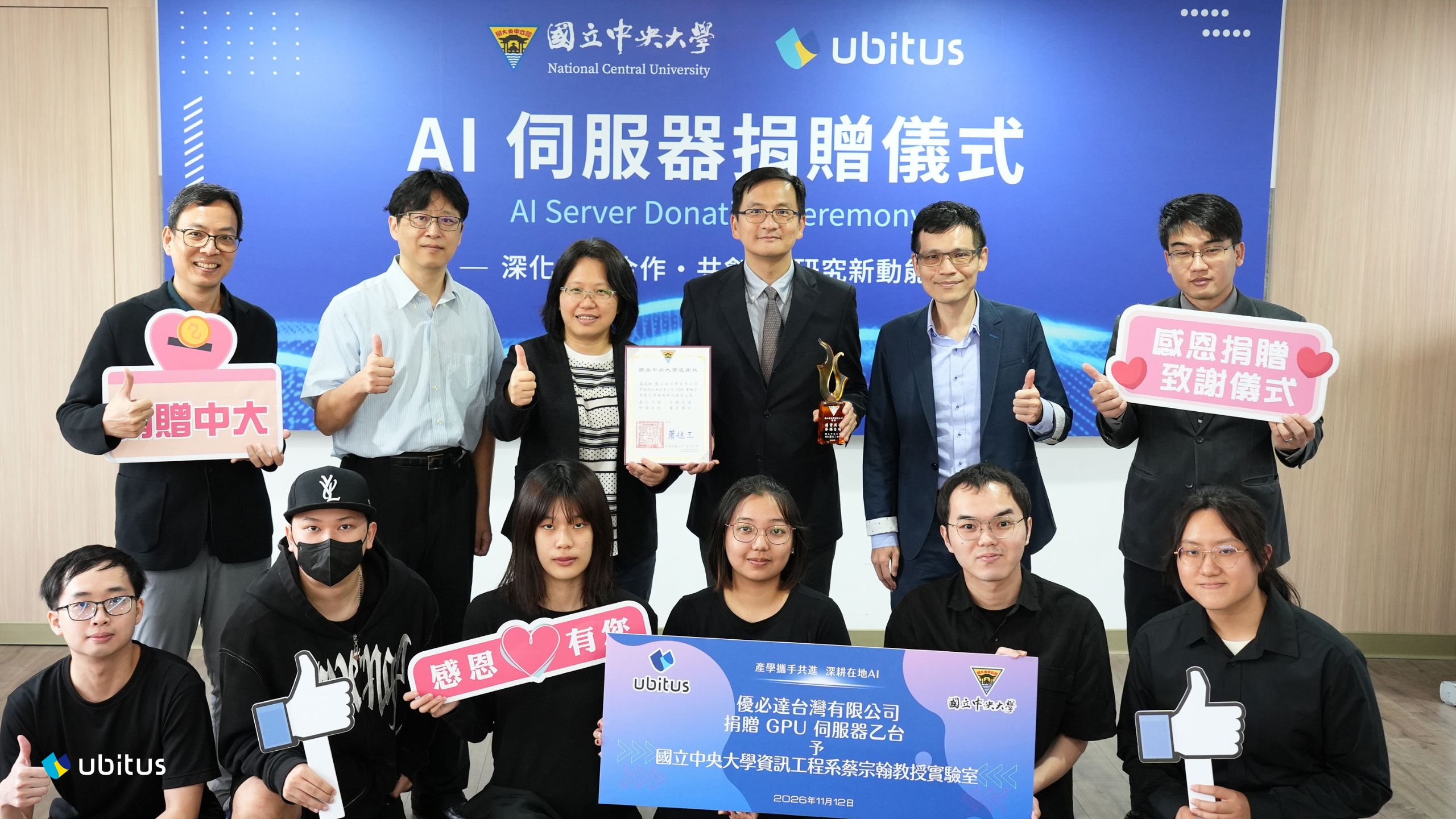
Industry–academia collaboration strengthens AI computing resources for research, accelerating local-language AI innovation and talent development
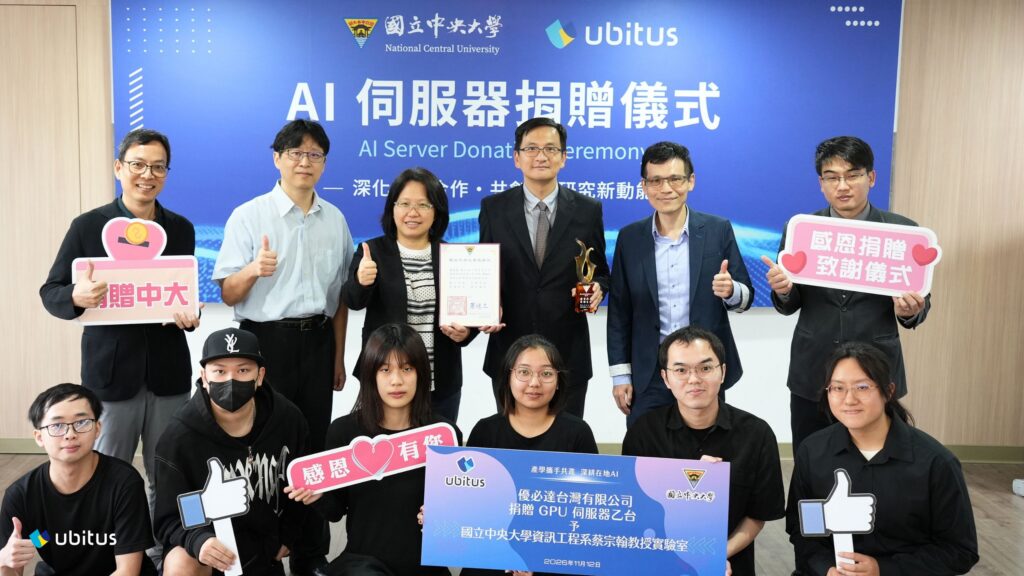
Global cloud streaming and artificial intelligence technology provider Ubitus announced the donation of a GPU server to the Department of Computer Science and Information Engineering at National Central University (NCU) during an AI Server Donation Ceremony held on November 12, 2026.
The server will be utilized by the Intelligent Information Service and Retrieval (IISR) Laboratory, led by Professor Tsung-Han Tsai, to support research in AI-powered Mandarin Chinese education, large language model evaluation, and Taiwanese language technologies. Ubitus CEO Wesley Kuo represented the company at the donation ceremony, while Professor Po-Lei Lee, Dean of the College of Electrical Engineering and Computer Science; Professor Wei-Jen Wang, Chair of the Department of Computer Science and Information Engineering; and Professor Tsung-Han Tsai accepted the donation on behalf of NCU.
Computing Power: A Critical Challenge for Academic AI Research
Generative AI research and applications require substantial computing resources. Compared with major international technology companies, academic institutions in Taiwan have long faced limitations in computing capacity for model training and evaluation. As a result, many research projects are restricted to smaller-scale experiments and less frequent testing, making comprehensive validation challenging.
By bringing industry-grade computing infrastructure directly into an academic research environment, this donation represents a concrete example of resource integration between industry and academia.
Ubitus has extensive experience in GPU virtualization, cloud computing, and AI computing infrastructure, with its core technologies expanding into large language models and generative AI applications. The company previously collaborated with National University of Tainan and other partners to develop “Tai-Ying-Hui,” an AI virtual human for Taiwanese–English bilingual learning, integrating the TAIDE (Trustworthy AI Dialogue Engine) large language model with AI virtual human technology to promote local-language education and cultural preservation.
Through this donation, Ubitus aims to connect industry computing resources with academic research needs, supporting technological exploration and innovative experimentation while providing students with greater opportunities to gain hands-on experience with AI computing technologies. The initiative also contributes to Taiwan’s sovereign AI development and the cultivation of future AI talent.
Supporting Mandarin Chinese and Taiwanese Language AI Research
Professor Tsung-Han Tsai of NCU’s Department of Computer Science and Information Engineering noted that generative AI research relies heavily on computing power, with substantial resources required for everything from model training to repeated testing. Due to hardware limitations, academic institutions in Taiwan are often restricted to small-scale experiments. The additional computing resources provided through this donation will help overcome research bottlenecks and accelerate technology validation and practical applications.
One key research area focuses on AI-assisted Mandarin Chinese education. Using the Taiwan Benchmarks for the Chinese Language (TBCL) as a framework, the research team is developing AI technologies capable of automatically generating leveled learning materials and assessments based on learners’ proficiency.
The primary challenge is not simply enabling AI to produce fluent text, but teaching models to recognize vocabulary that exceeds a learner’s proficiency level. Repeated training and refinement are essential to improving the appropriateness of educational materials.
In addition, the team is developing a large language model evaluation dataset covering Taiwan-specific knowledge and language-use contexts. By systematically comparing the performance of different AI models, the research aims to provide valuable references for the development of Taiwan’s independently developed language models.
Another research focus involves Taiwanese speech recognition, speech synthesis, and multimodal applications. Through international collaboration, the team is establishing evaluation benchmarks for different writing systems, opening new opportunities for the digital preservation of local languages.
Bridging the Gap Between Academia and Industry Through AI Talent Development
The donated server will be deployed at Professor Tsung-Han Tsai’s IISR Laboratory, providing researchers and students with access to more advanced AI computing environments for model training, evaluation, and related technical research.
Wesley Kuo, CEO of Ubitus, stated: “The development of sovereign AI requires not only computing infrastructure but also sustained investment in local-language technologies and talent. Through this GPU server donation, Ubitus hopes to support National Central University’s research in Mandarin Chinese and Taiwanese language AI, further strengthen industry–academia collaboration, and jointly advance Taiwan’s independent AI innovation and talent development.”
Looking ahead, Ubitus will continue leveraging its strengths in AI computing infrastructure and generative AI technologies, combining academic research capabilities with industry experience to support local AI innovation and talent development. Through these efforts, the company aims to contribute to a self-reliant AI innovation ecosystem that reflects Taiwan’s unique local characteristics.
About Ubitus
As a member of the NVIDIA Connect program, Ubitus leverages NVIDIA’s support and cutting-edge GPU technology to accelerate AI innovation. The company delivers advanced AI solutions, including UbiGPT (a large language model), UbiONE (an AI-powered avatar creation platform), and UbiArt (an image generation tool), providing customized solutions to meet the diverse needs of various industries.
As a cloud gaming pioneer, Ubitus enables Nintendo and other game companies to establish cloud gaming services and supports the global streaming of multimedia content, including interactive and virtual reality experiences.
Contact
TEL : +886-2-2717-6123 (Taipei)
+81-3-6435-3295 (Tokyo)
Media contact: pr@ubitus.ai
Business inquiry: contact@ubitus.ai
Website:www.ubitus.ai