When UbiChan Enters the AI Zoo: An Experiment in Character Personalities, Interaction, and Game Bridging
26-11-16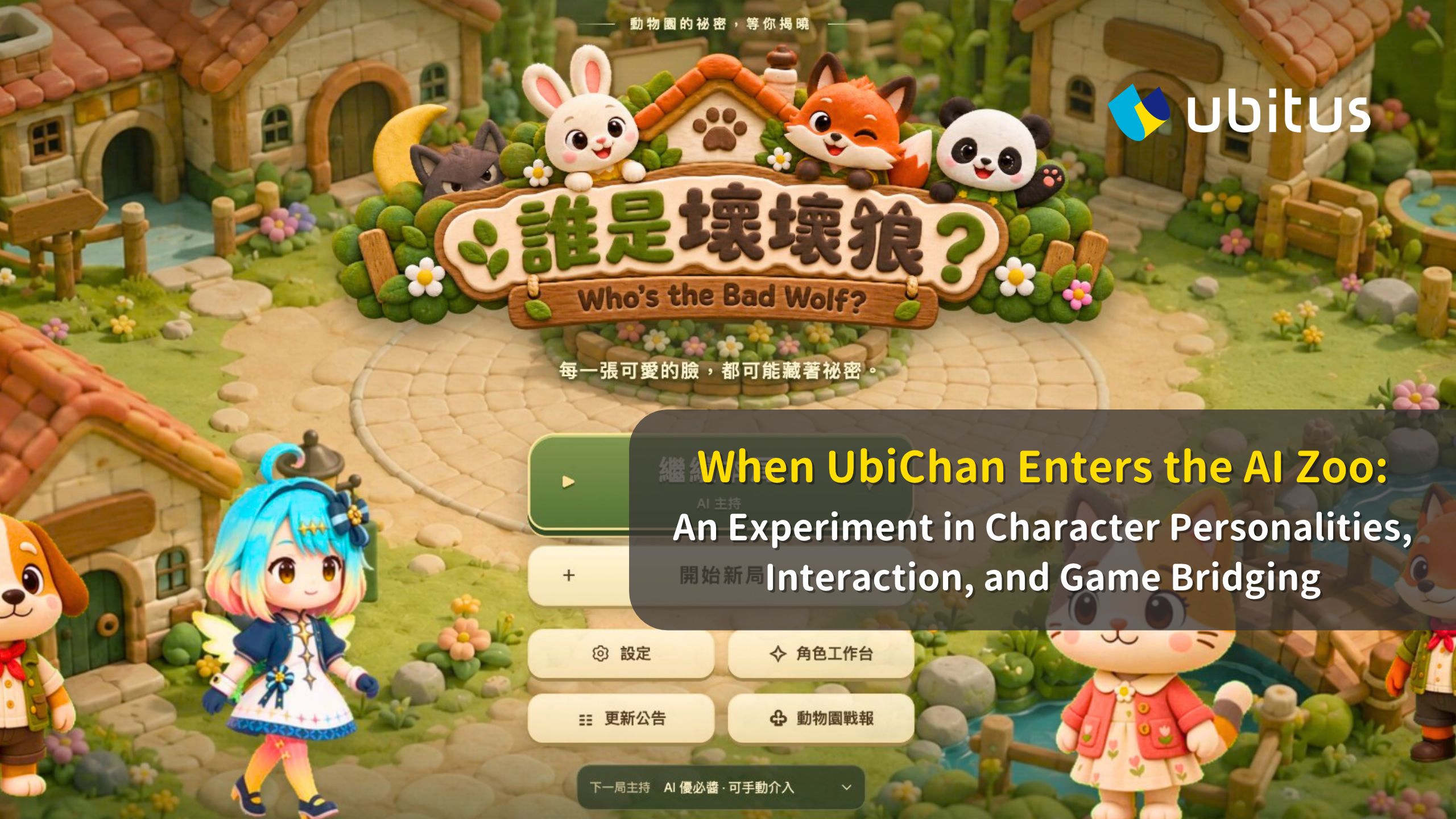
What would happen if a group of AI animals with completely different personalities came together, and Ubitus’ AI virtual brand ambassador, UbiChan, stepped into their world?
Some animals might rush to defend themselves, while others would calmly observe everyone’s reactions. Some would openly express suspicion, while others might ease the tension with lighthearted jokes. And when a hidden “werewolf” lurks among them, the once-peaceful zoo suddenly becomes a place filled with suspicion and dramatic tension.
With this idea in mind, our team created “Who’s the Bad Wolf?”, an experimental project combining multi-character AI performances, Werewolf-style social deduction gameplay, and real-time interaction with UbiChan.
What we wanted to explore was not simply whether AI could answer questions accurately, but something more intriguing: When AI characters have independent personalities and find themselves in constantly changing situations, how will they react in the moment?
At the same time, we developed a bidirectional Bridge Interface connecting UbiChan with the game system. This allows her to move beyond being a host who simply follows a script. Instead, she can understand the current game situation, discuss developments with livestream viewers, and independently decide whom to interview, what to ask, and which direction to take the conversation.
In doing so, UbiChan becomes an AI game player who actively participates in advancing the investigation.

Here are the four core design principles and technical insights we would like to share from this experiment.
Key Insight 1: Start with a Cast of Characters, Not a Set of Standard Answers
Werewolf is an ideal setting for observing character interactions. When faced with the same question, animals with different personalities should respond in completely different ways.
When UbiChan asks, “Who do you think is the most suspicious?”, a cautious animal might first review the clues collected so far. A straightforward animal might immediately name a suspect. Meanwhile, an animal that values friendship might express its doubts while hesitating to accuse a friend or worrying that someone it secretly admires could be caught in the conflict.
To create this authentic sense of an ensemble cast, we gave each animal its own persona, speaking rhythm, and hidden relationships.
We wanted viewers to see more than a lineup of chatbots waiting to be prompted. Instead, we wanted a group of characters with distinct attitudes and perspectives.
This also makes every question UbiChan asks unpredictable. Asking the same question to different animals can lead to entirely different paths of investigation.
The appeal of AI interaction lies not in producing a “standard answer,” but in the chemistry created when different personalities collide.

Key Insight 2: The Dual Dynamics of Personality and Hidden Identity
During development, we repeatedly considered an interesting question:
If the same animal is innocent in one round but becomes a werewolf in the next, is it still the same character?
In “Who’s the Bad Wolf?”, we designed each character’s underlying personality separately from its role assigned for each round.
At the beginning of every game, identities are assigned randomly, but the characters’ original speaking styles do not suddenly change.
For example, an animal that normally speaks bluntly will not suddenly become quiet and mysterious just because it has been assigned the role of a werewolf.
It will still speak in a direct manner, but may become more careful about revealing inconsistencies or try to steer the conversation in another direction.
Conversely, if the same animal is innocent but falsely accused, its straightforward personality may cause it to defend itself immediately and passionately.
On the surface, both situations may involve equally emotional responses, but the motivations behind them are entirely different.
This is exactly the kind of deduction experience we want to create: A character’s behavior is influenced by its hidden identity, but it is not completely defined by that identity.
Familiar animals can reveal different sides of themselves in every game, making it impossible for players and viewers to identify the werewolf simply by judging a character’s tone of voice.

Key Insight 3: Maintaining Emotional Tension and Factual Consistency Under Pressure
A compelling Werewolf game is never just about taking turns speaking.
As discussions intensify, characters may face accusations, be asked to explain their timelines, or even discover that trusted companions have begun to suspect them.
To make these interactions more dynamic, we designed the animals to adjust their attitudes according to the pressure of repeated questioning and their relationships with the person asking the questions.
At first, an animal may calmly explain its position. But when the same suspicious detail is repeatedly challenged, its tone may become more urgent, or it may even begin questioning the accuser in return.
If the suspicion comes from a companion it cares about, its response may reveal an additional layer of hesitation and emotional conflict.
However, there is one critical technical principle:
Emotions can fluctuate, but facts must remain consistent.
Every explanation, defense, and reaction must be strictly grounded in events that have already been publicly revealed in the game.
Enabling AI to express rich emotional tension while maintaining rigorous story logic and contextual consistency is one of the most challenging—and fascinating—aspects of this experiment.
Key Insight 4: Building a Bidirectional Bridge Interface Between UbiChan and the Game System
Another major technical breakthrough in this experiment was transforming UbiChan from a “host on the screen” into an autonomous AI Agent capable of interacting with the game’s underlying logic.
To achieve this, we designed a Bridge Interface connecting UbiChan with the game system.
This bridge must address two fundamental challenges.
- Rule Alignment and Action Boundary Control
Through the Bridge Interface, the game provides UbiChan with currently available public events and the range of actions permitted by the game rules.
For example, during the discussion phase, she can independently decide which surviving character to interview, what details to investigate further, or whether to proceed to the voting phase.
Once the game enters a short debate or voting phase, however, her available actions become more restricted according to the rules.
Only after the game receives and validates UbiChan’s decision does it advance to the next turn.
- Precise Information Isolation
The appeal of Werewolf depends on information asymmetry.
The Bridge Interface must ensure that UbiChan can access all publicly available information in real time for logical reasoning, while strictly preventing her from accessing any character’s secret identity.
This keeps UbiChan on equal footing with the viewers, allowing them to speculate together and preserving the excitement of the unknown.
True game-AI bridging is not simply about transferring data in one direction. It is about enabling AI to understand the rules and make autonomous decisions within clearly defined boundaries.

Starting from the AI Zoo: Exploring the Possibilities of Future AI Interactive Entertainment
Although “Who’s the Bad Wolf?” uses Werewolf as its setting, the underlying bridging architecture is highly versatile and extensible.
Its core process can be summarized as:
Public Game State → Autonomous AI Decision-Making → Game Rule Validation → Execution
In the future, this interaction framework could be extended to a much wider variety of scenarios.
In adventure games, UbiChan could independently decide which clues to investigate and which characters to approach.
In cooperative games, she could suggest tactical coordination based on the evolving situation.
In interactive narrative games, every question she asks could lead the story down a completely different branch.
This also reflects Ubitus’ long-standing technological development in the UbiOne virtual character platform and Multi-Agent collaboration architectures.
By combining low-latency cloud computing with rigorous memory and state-management logic, we aim to give virtual characters the ability to truly understand situations and respond in real time.
Lessons from Real-World Testing: Balancing Deep Reasoning with Livestream Entertainment
Beyond technical validation, our actual livestream tests also provided valuable insights into the viewer experience.
Werewolf involves complex verbal exchanges, strategic challenges, and detailed clues. However, asking viewers to process the statements of multiple AI animals while following the pace of the investigation requires considerable attention.
This led us to consider the next direction for optimization:
How can we preserve the excitement and unpredictability of AI improvisation while making the experience easier for viewers to follow?
Moving forward, we plan to continue experimenting with more intuitive visual presentation of clues, faster-paced interactions, and more focused character conflicts.
“Who’s the Bad Wolf?” represents another ambitious step in Ubitus’ exploration of AI interactive entertainment.
Starting with UbiChan’s journey into the AI Zoo, we have seen the tremendous potential that emerges when character personalities, game rules, real-time AI generation, and bridging technology come together.
- Watch the livestream: Who’s the Bad Wolf? on YouTube
About Ubitus
As a member of the NVIDIA Connect program, Ubitus leverages NVIDIA’s support and cutting-edge GPU technology to accelerate AI innovation. The company delivers advanced AI solutions, including UbiGPT (a large language model), UbiONE (an AI-powered avatar creation platform), and UbiArt (an image generation tool), providing customized solutions to meet the diverse needs of various industries.
As a cloud gaming pioneer, Ubitus enables Nintendo and other game companies to establish cloud gaming services and supports the global streaming of multimedia content, including interactive and virtual reality experiences.
Contact
TEL : +886-2-2717-6123 (Taipei)
+81-3-6435-3295 (Tokyo)
Media contact: pr@ubitus.ai
Business inquiry: contact@ubitus.ai
Website:www.ubitus.ai