UbiChan Surpasses 300,000 Views, Showcasing AI VTuber Evolution
26-07-03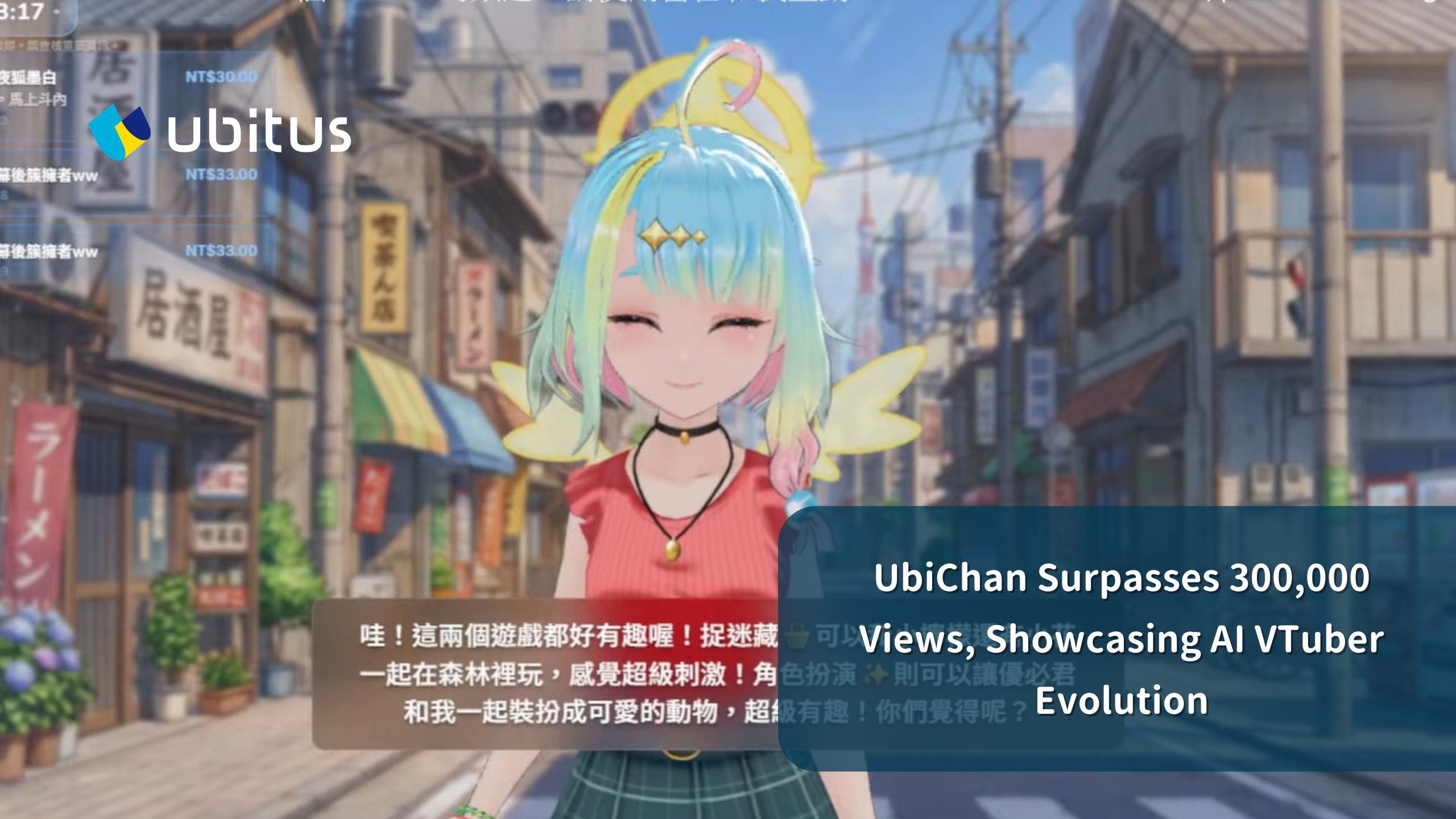
Author: Bull, BD & MKT Director | Editor: Helen, Deputy Marketing Manager
If a virtual character chats with everyone on YouTube every day, remembers each fan’s name, and even complains to you about getting stuck in a game last week, would you still think she is just cold, lifeless code?
Recently, Ubitus’ AI VTuber UbiChan officially surpassed 300,000 views and accumulated more than 10,000 hours of companionship, or watch time. These two numbers are especially meaningful to us because they show that viewers are willing to spend their valuable time with a virtual streamer powered by AI.
Looking back on this journey, it was never something that could be achieved with just one or two models. It was the result of collaboration across the entire team. We challenged three of the most difficult development barriers before AI could cross the boundary of being merely a “tool” and truly gain a captivating “soul.
Challenge 1: Moving Beyond One-Way Q&A to Build Human-Like Layers of Memory
Many companies fall into a misconception when adopting AI ambassadors: they assume that simply connecting the latest large language model, or LLM, will allow the character to interact with fans on its own. But real-world experience has shown us that an AI without memory and context is, at best, a voice jukebox with a beautiful appearance.
To solve the confusion of multi-person, multi-turn conversations, UbiChan was built with a three-layer memory processing mechanism:
- Short-term memory: the ability to “read the room”
In a live chat where comments keep flooding in every second, AI cannot respond like a robot by reading and replying to each message one by one. The system must filter out meaningless symbols or pure command messages, quickly identify the core topic currently being discussed in the chatroom, and generate an integrated response. It must also prioritize important messages from Super Chats or core fans. This dynamic filtering mechanism is the first line of defense in maintaining a smooth live-streaming experience.
- Mid-term memory: building community bonds
Why do fans stay connected to UbiChan? Because she can both “hold a grudge” and “show gratitude.” The system captures and preserves viewers’ recent speaking habits and preferred ways of being addressed. When AI can proactively continue an unfinished topic from a few days ago, or make an inside joke for a loyal fan, that feeling of “being remembered” becomes the key to building community loyalty.
- Long-term memory: accumulating a living worldview
The charm of a VTuber lies in the trajectory of continuous growth. The team continuously writes highlights from each program, major events that occurred, and hidden operational knowledge into UbiChan’s deeper database through memory summaries and save technologies. She is not a blank slate that gets reset every time she goes live. She is a vivid, living presence that grows together with time and her audience.
Challenge 2: AI Cannot Only Chat — A Real “Show Experience” Is the Core of Retention
After solving the logic of conversation, the next challenge was content fatigue. If a streamer simply stares into the camera and responds for two hours straight, viewers will quickly leave.
To support a true “show experience,” the team began having UbiChan try different types of content planning, including game streaming, singing, news broadcasting, video commentary, and AI drawing integration. An AI VTuber must be able to adapt to different content contexts. Behind this is not only the integration of more technologies, but also rigorous visual UI and experience UX design.
- Visual design
The UbiChan team designs suitable program scenarios and both vertical and horizontal layouts for each livestream theme. This allows fans to immediately feel the atmosphere of the day’s program as soon as they enter the stream. As the show progresses, the system can even automatically switch between different program layouts.
- Experience design
The team enables AI to design program segments for an entire day of livestreaming, creating a structured flow with opening, development, transition, and conclusion. At scheduled times, UbiChan can switch to important news broadcasts, lead new topic discussions, and even say goodbye to viewers near the end of the stream. These seemingly small details greatly improve the comfort of long viewing sessions and allow visibility and interactivity to reach a strong balance.
Challenge 3: The Symphony Behind the Scenes — Multi-Agent Collaboration and the Battle for Low-Latency Computing
After crossing the thresholds of memory and content planning, the biggest foundational technical challenge emerged. What viewers see on screen is UbiChan smoothly laughing, fighting monsters, singing, drawing, and reacting in real time. But behind the scenes, this is actually a millisecond-level “AI Agent symphony.”
To achieve high interactivity and real-time show pacing comparable to a human livestreamer, a single model is far from enough. It requires a whole group of AI Agents, each with its own role, operating rapidly in the background. Some agents monitor the context of chatroom comments and create summaries. Others maintain the numerical progression of the game world and provide background information. Still others must continuously search through short-term, mid-term, and long-term memory databases asynchronously, extract key information, and feed it into the core LLM for decision-making.
The biggest challenge is parallel multitasking and extremely low latency.
If AI hears a viewer’s Super Chat but needs ten seconds of background computation before responding, the atmosphere in the livestream is already gone. To allow UbiChan to respond as instantly as a human streamer, the system must coordinate multiple agent communications, memory retrieval, semantic understanding, 3D facial expression and motion triggers, and finally output speech through text-to-speech, or TTS, all within a millisecond-level window.
Completing massive data retrieval and parallel multitasking within such a compressed timeframe relies on Ubitus’ strongest core weapon: powerful GPU cloud infrastructure and compute resource orchestration technology. Without this level of enterprise-grade computing support, even the most intelligent AI soul would be trapped in a bottomless pit of latency and disconnection.
From a Soul Built Drop by Drop to the Birth of Enterprise-Grade SaaS
UbiChan’s soul was gradually formed through the layering of memory architecture and diverse program planning. But we understand clearly that most brands and marketing teams do not have the resources to bear such massive upfront development and trial-and-error costs.
This is exactly why Ubitus launched the UbiOne platform. We packaged the hard-earned experience gained from thousands of hours of real-world operation, including model fine-tuning, multi-layer memory integration, and cross-device code-free streaming deployment, into this SaaS platform. As a result, individual creators and enterprises no longer need to build a large R&D team from scratch. They can create their own AI virtual ambassadors with unprecedented efficiency.
Three hundred thousand views are only the beginning. When AI gains memory, its own stage, and the support of computing power, future brand marketing will no longer be rigid advertising pushes. Instead, it will become a long-term companionship co-created by virtual ambassadors and consumers.

About Ubitus
As a member of the NVIDIA Connect program, Ubitus leverages NVIDIA’s support and cutting-edge GPU technology to accelerate AI innovation. The company delivers advanced AI solutions, including UbiGPT (a large language model), UbiONE (an AI-powered avatar creation platform), and UbiArt (an image generation tool), providing customized solutions to meet the diverse needs of various industries.
As a cloud gaming pioneer, Ubitus enables Nintendo and other game companies to establish cloud gaming services and supports the global streaming of multimedia content, including interactive and virtual reality experiences.
Contact
TEL : +886-2-2717-6123 (Taipei)
+81-3-6435-3295 (Tokyo)
Media contact: pr@ubitus.ai
Business inquiry: contact@ubitus.ai
Website:www.ubitus.ai


