[Part 1] The Era of Bringing AI Assistants Into Your Own Data Center Has Arrived: UbiGPT × UbiCode × UbiWork On-Premise Enterprise AI Collaboration Solution
26-08-26
Author: Isaac, AI and Cybersecurity R&D Director | Editor: Helen, Deputy MKT Manager
Open-weight models are advancing rapidly. Two years ago, they were like interns whose work had to be checked line by line. Today, they are approaching the level of full-time employees with master’s or doctoral-level capabilities. As model capability is no longer the bottleneck, “whose machines the model runs on” has shifted from a technical preference to a core issue of cybersecurity and cost. The era of bringing AI assistants into your own machine room has arrived.
Preface: Model Capability Has Crossed a Threshold
Over the past few years, one of the strongest arguments against self-hosted AI has been: “Open-source models are not strong enough, and the money saved will be lost through lower quality.”
That premise is beginning to fail, and it is failing faster than most people expected.
A simple analogy explains this progress. Two years ago, open-weight models were like interns: you had to break tasks down into small enough pieces, provide enough context, and still check the output line by line. In many cases, reviewing the output took longer than doing the work yourself. One year ago, they were closer to entry-level employees: able to complete tasks with clear specifications, but likely to get stuck or make guesses when the requirements did not cover every detail.
Today’s generation of open-weight models is already approaching the level of full-time employees with master’s or doctoral-level training:
- They can understand the full context, rather than simply responding to the last sentence.
- They can break down vague requirements into executable steps and clarify key assumptions before taking action.
- They can judge their own output, knowing where they are uncertain and what needs verification.
- When errors are pointed out, they can correct them specifically instead of rewriting everything and hoping for the best.
Together, these four capabilities create a qualitative shift: output has moved from “something people need to redo” to “something that can be used directly.”
The cost implications of this difference are far more important than benchmark scores. When AI output still requires people to spend time polishing and finishing it, what you save is not truly working time. You have merely moved the work from “writing” to “editing.” But when the output can be used directly, the savings become real.
At this moment, three lines are converging:
- Model capability has crossed the “deliverable output” threshold, so self-hosting no longer means compromise.
- Inference frameworks and hardware have matured to the point where mid-sized enterprises can afford practical throughput.
- The demand for data sovereignty is rising rapidly as the data AI reads becomes increasingly sensitive.
The first two lines remove the technical and cost barriers to self-hosting. The third turns self-hosting from “worth considering” into “something that must be done.” The era of bringing AI assistants into your own machine room is arriving precisely at this intersection.
This article discusses the practical questions that come after this era has arrived: why data must remain within your own boundaries, how we use it internally across five real-world scenarios spanning legal, sales, R&D, and infrastructure, and what three layers make up a complete self-hosted solution.
1. The Question Is Not “Should We Use AI?” but “Where Does the Data Flow?”
Over the past two years, most enterprises have adopted AI in similar ways: legal teams paste contracts into chat windows, sales teams upload sales reports, and engineers install cloud-based IDE plugins, enter API keys, and let them read project source code. These workflows can function, but a closer look reveals several issues.
- To be useful, AI needs full context. If AI only sees fragments, it can only provide fragment-level answers. Truly valuable tasks—reading through an entire contract, analyzing a full year of sales data, or understanding an existing system—are essentially “large-scale reading + repeated inference.” A single task may read hundreds of files or an entire unpublished document, and all of this content leaves the company network. The depth of context equals the size of the data exposure surface.
- “Not used for training” is a term, not an architecture. Most commercial API terms do state that enterprise customer data will not be used for training, but this is a contractual promise. Once terms are updated, an account is accidentally configured as a consumer plan, or traffic passes through a different intermediary gateway, control is no longer in your hands. Terms can change; network topology does not change by itself.
- Costs scale linearly with usage and are unpredictable. Under token-based pricing, an AI that “works hard” becomes more expensive. When it starts scheduling tasks automatically, checking repeatedly, and iterating on fixes, the token consumption of a single task may be dozens of times higher than that of manual prompting. Monthly bills become impossible to estimate in advance.
- Compliance reviews are often the first obstacle. In finance, healthcare, game operations, government tenders, or any collaboration project under NDA, the question of whether a document or piece of code can be sent to a third-party service is enough to stop an entire adoption plan in the legal meeting room.
These four issues point to one common solution: bring model inference, identity authentication, and the AI execution environment back inside a boundary you control.
2. Four Practical Benefits of On-Premise AI
1. The Privacy Boundary Becomes the Network Boundary
When inference services run on internal GPU nodes, “data does not leave” no longer depends on trust. It can be verified through firewall rules. Contracts, quotations, sales details, internal wikis, project source code, and production environment logs read by AI all flow within the same VLAN. During an audit, what you can present is not a vendor’s compliance white paper, but a network topology diagram and a set of egress blocking rules.
2. Confidential Data Will Not Become Training Material
The weights of a self-hosted model are static. Unless you initiate a fine-tuning pipeline yourself, no conversation will flow back into the model. Pay attention to the subject here: whether something is used for training becomes your own choice, not a question of vendor terms. Later, Section 5.4 will discuss how to turn this choice into an advantage.
This is especially critical for three types of assets:
- Technical implementations that have not yet been patented. Once they become training data for a third-party model, the risk related to prior art determination becomes difficult to quantify.
- Documents and deliverables protected by customer NDAs, such as contracts, specifications, and integration code. Your confidentiality obligations to customers cannot be transferred simply by saying, “Our vendor says they will not use it.”
- Trade secrets that are not protected by patents or copyright, such as pricing strategy, cost structure, customer lists, and negotiation bottom lines. The value of these assets depends entirely on others not knowing them. Once leaked, they cannot be restored, and rights may be difficult to assert.
3. Costs Shift from Variable Expenses to Fixed Assets
This is one of the most easily underestimated points. Commercial APIs are variable costs and are positively correlated with “how well AI is being used.” The more skilled the team becomes and the more automation runs, the higher the cost. This effectively taxes correct usage behavior.
Self-hosted inference, on the other hand, is a fixed cost. Once GPUs are deployed, the marginal cost of running one more task approaches the cost of electricity.
A sample estimate, using numbers for illustration only and to be replaced with your own stress test results and quotes:

The point is not which option is always cheaper. The point is that the cost curves are shaped differently. For small teams and low usage, APIs are almost certainly more cost-effective. But once usage crosses the break-even point and continues to grow, the marginal advantage of self-hosting keeps expanding, and you can confidently encourage the team to “use it more.”
It is also worth noting that the table above assumes all tasks are handled by the same model. This is actually the least efficient approach. Later, we will discuss how assigning different types of work to different model tiers can further reduce costs significantly.
4. Availability and Latency Are Under Your Control
There are no third-party rate limits, no cross-border round-trip latency, and no situation where a vendor’s service degradation brings the whole company’s operations to a halt. First-token latency for internal network inference is usually significantly better than that of cross-region APIs. For automated workloads where one task may involve dozens of inference round trips, the accumulated difference is substantial.
3. Real-World Validation: Ubitus’ Internal Use Cases
The four points above would not be persuasive enough if they remained purely theoretical. So before discussing architecture, we should first clarify one thing: this system is already being used across Ubitus internally.
It is not a demo created for external sales. It is infrastructure that we run every day ourselves—and not only in the R&D department. The following five scenarios span legal, sales, software development, and infrastructure tuning. They are all completed within the internal network, with no document, data record, or line of code leaving the company network.
Please note the common characteristic of these five scenarios: they are not cases where “AI gives suggestions and people redo the work.” Instead, AI directly delivers usable results. This is exactly the threshold mentioned in the preface. If the model still required line-by-line checking, none of these five tasks would be worthwhile.
3.1 Legal: Initial Contract Review and Tracked Revisions
Contracts are probably among the document types least likely to be uploaded to cloud AI. They contain customer names, licensing terms, pricing structures, breach clauses, and are often bound by another NDA. Using a third-party AI service to review contracts is often rejected by compliance almost without discussion.
In a self-hosted environment, this restriction disappears. As a result, we use UbiWork as the first line of defense for legal review:
- Initial review and risk marking: AI reads the contract in full, compares the rights and obligations of both parties clause by clause, and flags clearly imbalanced terms such as unilateral indefinite confidentiality obligations, asymmetric liability caps, termination conditions that bind only one party, or acceptance standards vague enough to be interpreted arbitrarily.
- Revision suggestions: For each flagged clause, AI provides specific rewriting directions instead of merely saying, “This is unfavorable to us.”
- Human confirmation: Legal colleagues review AI’s judgments one by one, then accept, modify, or reject them. This step cannot be skipped. AI is the initial reviewer, not the decision-maker.
- Direct output of a ready-to-send file: After confirmation, the system directly generates a Word file with tracked changes and comments. The format is fully consistent with manual revisions and can be sent directly to the counterparty.
Step 4 is the real key to the whole workflow. Most AI legal tools on the market output a “list of suggestions.” Legal staff still have to open Word, move each revision in manually, and add comments one by one. This transfer work often takes more time than the review itself. Directly producing a deliverable file is where the real time savings happen.
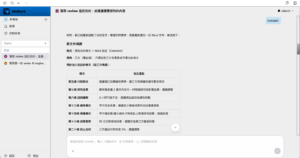
UbiWork actual screen: AI reads the contract from the perspective of Party B and lists the clauses and reasons recommended for comment, including payment acceptance standards, interim report timelines, warranty and infringement liability caps, and deemed acceptance through silence. After confirmation, it can directly output a Word file with tracked changes.
3.2 Sales: Sales Data Analysis and Insights
The second scenario is also outside the R&D department: uploading an Excel file of sales data to UbiWork and asking it to analyze the data and provide insights and recommendations.
The difficulty of this task usually lies not in the analysis itself, but in the preparation work. Traditionally, data engineers first need to build a pipeline, import the data into a BI system, and design dashboards. A temporary question may have to wait two weeks before getting an answer.
Now the process is simple: upload the file and ask the question directly.
Actual use cases include interpreting trends and seasonality, locating anomalies and possible causes, comparing product lines and regions, and proposing concrete actions based on the findings. With scheduling features, the analysis can also be set to run automatically every week, so managers receive the latest summary first thing in the morning.
The sensitivity of sales data needs no further explanation. Revenue structure, customer contribution, and pricing strategy are exactly the kinds of information competitors want most. The only reason these data can be safely handed to AI for analysis is that the model runs in our own machine room.
3.3 R&D: CI Integration—Tests Grow by Themselves After Commit
We connect AI Agents directly into the CI pipeline. After an engineer runs git commit, the Agent automatically analyzes the changes and completes the corresponding unit tests.
The value of this becomes clear only when viewed through actual working time. In software development, roughly half the time is spent writing tests. It is a necessary half that engineers acknowledge, but it is also the half that often brings the least sense of achievement. It does not create new features, but without it, no one dares to refactor, and deployment becomes an act of faith.
Now, AI helps us save that half of the time.
More importantly, it changes team behavior. In the past, “Let’s skip tests for now and add them later” was a standard compromise when projects were under time pressure, and “later” usually never came. When the cost of adding tests approaches zero, test coverage no longer depends solely on discipline. It becomes a natural product of the workflow.
3.4 R&D: Automatic Initial Review—Making Shift-Left Truly Start at the First Step
On the same pipeline, the Agent also performs an initial code review of each change.
The result is straightforward: it has already successfully found bugs in human-written code multiple times. Note that this refers to code written by humans, not by AI. If these issues had not been caught, the best-case scenario would be a colleague catching them during code review, wasting two people’s time. A more typical case would be discovering them in QA, wasting a testing cycle. The worst case would be production failure, wasting an entire team’s evening.
People have been talking about shift-left for years, but the real difficulty has never been the concept. It is the contradiction between “the earlier you check, the lower the cost” and “the earlier you check, the less human capacity is available.” No team can afford a senior engineer dedicated to reviewing every person’s code line by line at the moment of commit.
The AI Agent fills precisely this gap. It does not get tired, does not care about time of day, and treats every commit equally. Defects are intercepted at the first step of their lifecycle, and disasters disappear before they become disasters.
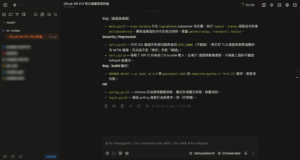
UbiCode’s automatic review result for GitLab MR #12: issues are categorized by severity, with files and line numbers identified one by one. In cert.py:25, SSL verification failure was automatically downgraded to no verification. This type of code—appearing to work while actually disabling TLS checks—is exactly the kind of issue that human review can easily miss.
3.5 R&D: A Quality Loop That Reviews Until There Are No Further Comments
This is one of the practices we believe best demonstrates the value of on-premise deployment.
We let AI review code—whether the code was written by itself or by another model. After identifying issues, it fixes them automatically, and then reviews again. This process repeats until the reviewer can no longer provide any additional revision suggestions, and only then is the result delivered.
Technically, this loop is not complex. The challenge is its cost structure. A single task may require a dozen or even twenty rounds of inference. Under token-based pricing, this approach would almost certainly be stopped by management when the monthly bill arrives. The team would start asking itself, “Is this task worth running one more round?” Quality is sacrificed in precisely this kind of calculation.
A self-hosted environment removes this concern entirely. The GPUs are already in the machine room, and the marginal cost of running ten more rounds is only electricity. We can therefore confidently tell the team: do not worry about burning tokens; run it until it is good.
The result is an overall improvement in output quality and a very practical change: what AI delivers is a “directly usable result,” not “a draft that still needs a human to finish.” The difference between the two determines whether AI-assisted development truly saves time, or merely moves the work from “writing” to “editing.”
3.6 Infrastructure: Letting AI Tune AI’s Own Inference Engine
The final scenario is more unusual: we let AI optimize UbiGPT’s own inference engine.
Anyone who has deployed models knows that “serving a model” and “serving a model as fast as possible” are two different things. The latter has an enormous search space: tensor parallelism, batch size, KV cache configuration, quantization strategy, maximum context length, scheduling parameters, and more. Each affects the others, and no single set of parameters is optimal for all workloads.
Traditionally, senior engineers try this manually: change one set of parameters, deploy, run benchmarks, wait for results, record them, and then change the next set. The problem is not that it is difficult. The problem is that it is both extremely time-consuming and extremely mechanical. Engineers spend most of their time waiting for benchmarks to finish and copying numbers into spreadsheets.
Now this process is handled by AI through multi-round automated iteration:
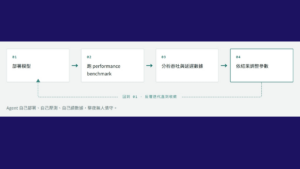
The Agent deploys by itself, stress-tests by itself, reads the data by itself, and runs unattended overnight.
The Agent deploys, stress-tests, reads the data, decides which parameter set to try next, and runs again. After running through the night, the next morning we receive a complete parameter sweep result and best-configuration recommendation, supported by measured data from every round.
The benefit of this scenario compounds. Throughput improvements from tuning directly reduce the cost of each inference, and the lower cost makes the high-frequency use cases above more economical. Using AI to optimize AI infrastructure, then feeding the saved computing power back into AI, creates a self-accelerating cycle.
3.7 Summary: Five Scenarios, Two Shared Premises
Looking back at these five scenarios, they span completely different departments and types of work, but share two premises.
The first premise: the most sensitive data can only be given to AI when it stays inside the internal network.

These tasks can be handed to AI not because we trust a vendor’s terms, but because the data never leaves the machine room.
The second premise: inference costs must be predictable and must not punish high-frequency use.
- Every commit automatically generates tests → high-frequency triggers, extremely high usage.
- Every commit automatically receives code review → high-frequency triggers, extremely high usage.
- Repeated self-review and self-correction → extremely high usage per task.
- Multi-round parameter sweeps and stress tests → continuous overnight computation.
If any of these were placed under a usage-based pricing model, the discussion of whether to limit frequency would arise immediately. In a self-hosted environment, that discussion does not need to happen at all.
This is why we believe on-premise deployment is not a conservative choice, but the prerequisite for AI to truly deliver value.
In the next article, we will further break down how UbiGPT, UbiCode, and UbiWork correspond to inference governance, R&D Agent teams, and cross-department AI collaboration, forming a complete On-Premise enterprise AI solution.
About Ubitus
As a member of the NVIDIA Connect program, Ubitus leverages NVIDIA’s support and cutting-edge GPU technology to accelerate AI innovation. The company delivers advanced AI solutions, including UbiGPT (a large language model), UbiONE (an AI-powered avatar creation platform), and UbiArt (an image generation tool), providing customized solutions to meet the diverse needs of various industries.
As a cloud gaming pioneer, Ubitus enables Nintendo and other game companies to establish cloud gaming services and supports the global streaming of multimedia content, including interactive and virtual reality experiences.
Contact
TEL : +886-2-2717-6123 (Taipei)
+81-3-6435-3295 (Tokyo)
Media contact: pr@ubitus.ai
Business inquiry: contact@ubitus.ai
Website:www.ubitus.ai